Frosty Limes

Brrrr, it’s cold here.
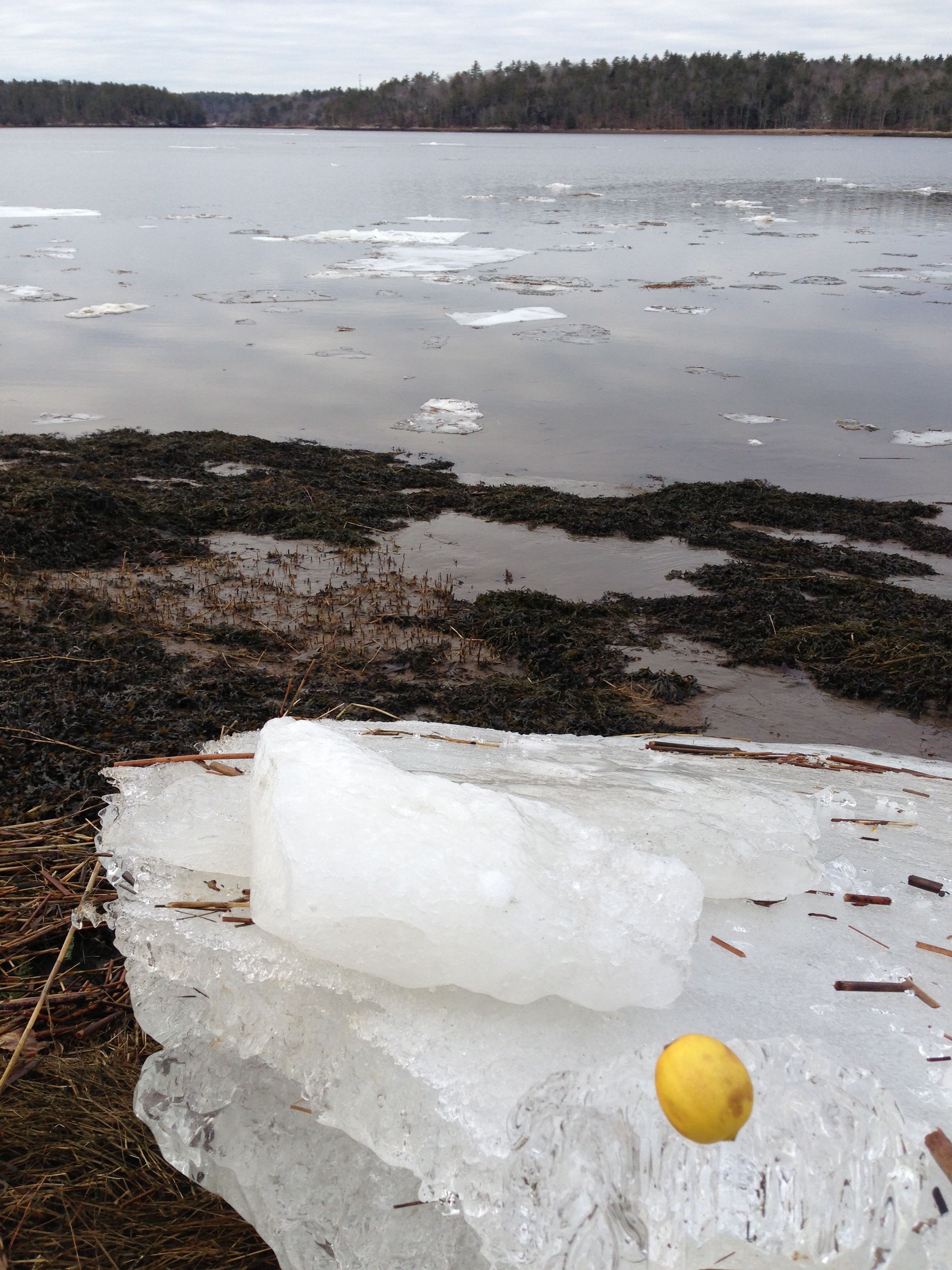
limeonice

This is one of my limes at a friend’s house in Maine.

But it’s feeling very cold here in Oakland even. Frost warnings at night. What’s a citrus farmer supposed to do? Wrap my trees, that’s what. Whenever I hear the temps will be in the low 30s, I drape the citrus trees with floating row cover aka Agribon aka Remay. This acts like a jacket for the tree–the spun poly fibers raise the temperature around the tree by almost 5 degrees.

Now, the other thing to do is to spray the plant with water. To us mammals, this sounds like an insane survival strategy. To understand how it works note that water has three phases: ice, water, and stream. To get ice to melt takes energy, just like it takes energy to make water boil. When water is going through a phase change, energy is given off. As water freezes into ice, heat is actually given off. A hydrated plant then, will be a warmer plant. If you love ’em, cover ’em.

Speaking of fruit, the Golden Gate chapter of the scion exchange is happening this weekend! Saturday, 12-3 at Ed Roberts Campus in Berkeley by the Ashby BART. http://www.crfg.org/chapters/golden_gate/scionex.htm. If you’ve never been, get ready for a fruit-seeking thrill like no other.

Hibernation

Hey y’all. Really, I’m here. But just for a second. There are big plans brewing over this winter, getting ready for a big spring. In short, I’m dormant right now, but rooting around the deep depths.
One new thing to share: I graffitied my own damn fence. I have been really bummed around a certain posse of taggers that kept tagging my fence with their name: Bob. Bob? In bubble letters? In expensive silver spray paint (cans thrown into the garden post-tag)? Fuck you Bob, you are hitting my vegetables with your spray paint. So I hired some locals and they tagged my fence and made it look purdy.
graffiti
I’ve heard that taggers won’t tag other respected taggers graffiti. Hey, I’m working with what I’ve got, fighting fire with fire.

Politics

I usually steer clear of politics. I hate our two-party system and wish we could have other choices. But I have been listening to the debates, and I admit that I cheered a couple times during Barack’s come-backs to Romney (“we don’t have as many horses and bayonets either.”) But there is one issue on the California ballot that could actually change things: Prop 37. It basically requires food to be labeled if it is genetically modified. I worked in genetics labs for years when I was studying Biology at the University of Washington. Among other things, I sequenced DNA. We were fumbling around in the dark. We didn’t know then (or now) exactly how DNA worked. There’s an elaborate signaling system (I was studying protein kinase receptors) that is still being worked out.

So when I hear that scientists are genetically modifying food, I think I know what that looks like. Lots of growing vector bacteria, lots of scattershot insertion of DNA into that vector, and then the insertion of the replicated DNA into the organism. Grow the genetically modified plant out and see what happened. It is science, but that doesn’t mean it’s exact. I’m all for science–I love that I don’t have polio or that, during flu season, I can get a flu vaccination. But science needs to be tested to be sure it’s safe. The GMO plants don’t seem like they have been put through vigorous enough trials to prove that it’s absolutely safe for human consumption. That’s why I’m voting yes for 37! (If you don’t live in Cali, if it passes here, it might show up in other progressive states soon).

Also, tonight (October 23) I’ll be doing a reading/talk with Rebecca Solnit at USF Cowell Hall, Room 106. 7:30. I’m bringing figs and limes–GMO free, naturally.

Mastering Artisan Cheesemaking

Ok–drumroll…the winner is–though I love you all–Eliza, the 13 year old cheesemaker! I love her moxie and enthusiasm. Don’t worry, there will be other contests like this in the future…

No, don’t worry–I haven’t mastered it. But, you know who has? A woman named Gianaclis Caldwell. She has a Nigerian Dwarf goat farm and farmstead cheese operation up in Oregon, called Pholia Farm. She wrote a DIY book about starting a creamery, and she makes some dank-yum cheeses. Now Caldwell has an excellent book out called Mastering Artisan Cheesemaking.

You might be surprised to hear I once took classes at the Vermont Institute of Artisan Cheesemaking. When I was five months pregnant, I suddenly panicked that I would never have the chance to learn from the pros how to make cheese once the bambino came along. I imagined that I would sink into a deep depression because I had no time to study the art and science of cheesemaking post-baby; that I would yearn for what I hadn’t done. I was actually right–I won’t be able to take a two week-long class in Vermont for the next, oh, 10 years–so it was good to get it out of my system. I did love Vermont–and I loved classes there. We made huge f-ing vats of gouda and stabilized soft cheeses. We learned about the science of how milk becomes cheese, how the molecules are interacting during the setting process; about different kinds of rennet; about pH, and how that makes a cheese behave a certain way. And, I also learned that I would never be a professional cheesemaker. I’m not sanitary enough for bulk production, and I’m easily bored with repetitive tasks.

But I do love making cheese at home. In the past I’ve used New England Cheesemaking direct set kits–little packets which include the cultures and some rennet; but after cheese school, I started buying culture and rennet separately, and being a bit more experimental with it. If it turns out funky (sorry mom, about that cat hair fig leaf number I sent you last autumn), I can just throw it out. If it’s good, I can share it with friends and feel a little god-like. So I don’t regret spending the time and money to go to Vermont.

It turns out, though, that I didn’t have to go to cheese school at all, because Caldwell’s book covers all the stuff I learned in class. I’m offering a galley copy of the book to a reader who posts the best comment about why they would like to read the book.

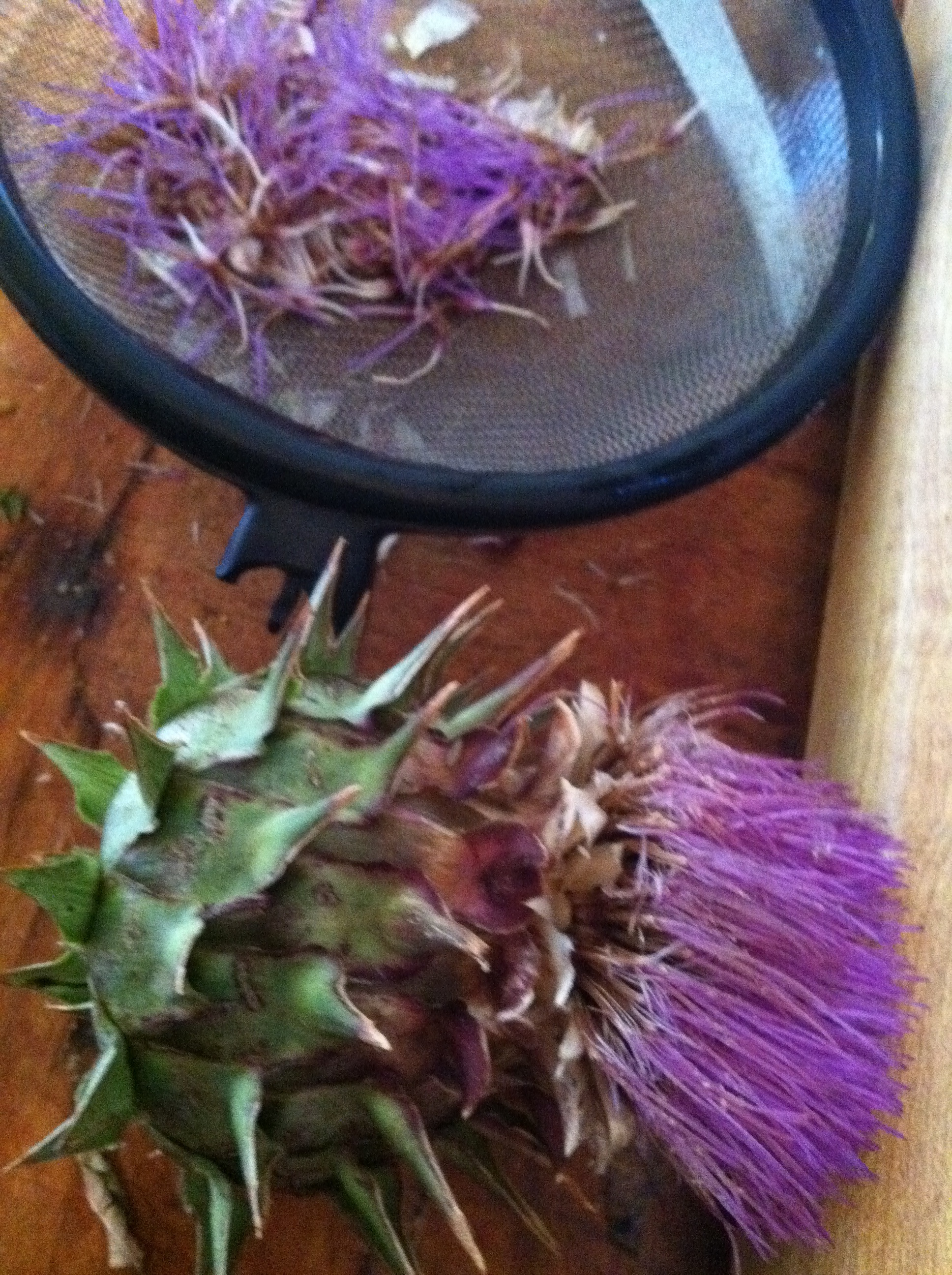
One of the sidebars in the book is about making rennet out of cardoons. I happen to have a lot of cardoons (they are pretty but weedy), so I was eager to try making my own vegetarian rennet (I once made my own rennet from a goat’s stomach, and it took forever…). First I picked the cardoons when they had bloomed and were purple.

Then I sat around and pulled out the stamens. As directed, I tried to dry the stamens then grind them up, but they wouldn’t grind. So I just soaked them in water water for 30 minutes, then decanted the liquid and put it in a jar, ready for cheesemaking. Except then someone thought it was just a jar of dirty water and poured it down the sink. Undaunted, I picked more stamens and soaked them in water. While that happened, I heated up the milk as Caldwell directed, to make chevre. Then Franny kicked the container of the second batch of cardoon water over. So I used rennet I had in the fridge, and the tailings of the cardoon water.


Maybe it’s the book, maybe it was the small amount of cardoon–but this cheese turned out better than any I’ve ever made. It’s super creamy and yum. I innoculated with some geotrichium, so the ones allowed to age will form a nice bloomy rind. Thanks Gianaclis!! And to D’s goats who provided the milk.

Clearing It Out

A few months ago I finally got my permit from the City of Oakland. It came in the form of a letter. And with that, a chapter closed. A messy, annoying chapter.

Today I finally had the time to return the yellow placard that’s been up in front of the gate for the last year. One of the inspectors told me I’d get a $50 deposit back if I brought in the City of Oakland permit application sign. So this morning, I cut it down from the zip-ties that had been holding it, glad to finally be rid of the thing (it confused people–some who thought the lot was owned by the city; others who thought it was ok to call me on the phone number provided just to say “hi.”). I rode my bike to the City Hall’s planning Department with the sign balanced in one hand.

For those of you who don’t know the whole story of the permit, here’s the recap: May 2011 the City of Oakland came to me and said I needed a permit for crop and livestock raising activities on my commercial lot. The permit would cost almost $3000 (one time fee). People who read this blog sent me the money via paypal, the mail, and in the farmstand tip jar–which, BTW, is fucking amazing! thank you all who helped save Ghosttown Farm! If I didn’t send you a postcard thank you, know that I meant to but I got real busy. Upon submitting the fee, I had to jump through a lot of hoops, and figure out how to defend my right to farm. Luckily, I was aided by the genius legal council of Janelle Orsi and Philip Heiselmann. They cut through the legalese for me, and explained, step by step, what I should do. I’m eternally grateful to them. If you need a good lawyer, I’ll give you their contact info.

While waiting for the permit, I got pregnant and all the plants died, and I could barely remember to feed the rabbits (but I did, you nosy NOBS people, I still did). I shifted my priorities–having a child meant having a farmstand that makes $5 profit doesn’t really make sense to me anymore (as fun as it was). I realized I don’t have time for livestock (except for bees), and sold or gave all the critters away. I also discovered that I don’t think it’s cute when I see a man shooting up in the garden (which just happened last week). And so, I’m locking the gates to the farm, which have been open and free since 2003 on October 1, 2012.

What’s the plan? The farm is turning into an orchard. With the help of Molly Bolt, we will be planting all the trees that have been in containers, so that the land will have over 25 fruit trees growing there, adding oxygen and sweet smells to the air. Eventually, once Francis is older, the trees will start producing fruit–maybe enough to sell, maybe not. I’ve learned so much from that little parcel of land, and it’s not over yet. Though the gate will be locked, I’ll still be posting about various happenings…stay tuned for a post about making cheese with cardoon flowers…

At the permit office, I handed the lady at the desk the big yellow placard. A spider crawled out of the middle of the sign, wondering where the hell it was. She whisked it away and sent me to the cashiers desk. The woman there told me–oh, you don’t get a refund because you never paid it. I just shrugged and laughed to myself: it’s the perfect way to end that process.

If you’d like to take a class with Molly that is in conjunction with the orchard plant at GT Farm, please email me–my name at the big G–and I’ll give you details.

And!
Willow and I will be at the Dublin and Fremont Public Libraries Sept 22. Fremont 12-1:30; Dublin 3:30-5pm–come on by if you live round there…

Dry Farmed ‘Maters

Yeah, I talk in baby talk now. Like taters and maters. I slur a little bit to create a country kind of twang.
So…dry-farmed tomatoes. I did it this year, with stupendous results.

The skins are very sturdy (don’t want to say tough) and inside is the sweetest, juiciest yum sweet tomato. This is a plate of them with black sea salt from that new cool spice shop called the Oakland Spice Shop on Grand. They are also very good to can, as they hold their texture and don’t go all wobbly in the jar.

Why are they so damn good? Basically I tortured them. The French say the grapes must suffer in order to make the best wine. Same principle with dry-farmed tomatoes. Here’s how it works. In the spring you amend the future tomato bed with a deep layer of compost goodness and a thick layer of straw mulch. Then let the winter/spring rains do their thing. Before planting the tomato plants, soak the area with plenty of water for a long time, then plant. As they grow, keep them irrigated. Then, around May (this is in the Bay Area when you can plant maters in March, later in other areas), stop giving them water entirely. Because of this lack, they will look terrible, unhealthy:

(Note that I should have staked them up but I’ve been distracted) As the hot summer goes on, you might even feel bad. But don’t water them!! Having no water makes them dig their roots in and make some tasty sacrifices–what they give up in vegetative growth, they give to the fruit. Small fruit, mind you, about the size of a golf ball. But they are flavor explosions!!! Not only does it make the best tasting tomato ever, it also saves water. That’s a win-win.

I didn’t grow enough to can them (that’s where my duck barter comes in) but they are a wonderful snack or salad addition.