Cheese Geeking

Only two years ago, I got my first goat, Bebe. Oh how much I’ve learned since then, including hoof trimming, worming, vet testing, feeding, cooper bolus adminstration. And oh how much I still have to learn: goat psychology, training young does to be milked, bottlefeeding, and shearing.

Of course there is no real endpoint of the education of a goat owner. There are always new tricks to learn, new goats to learn from, and new skills to acquire. One of my favorite lessons has been the craft of making cheese. This year I made the decision to not breed Bebe and have her go through a long lactation. Even in the dead of winter, she is milking away like a mo-fo. I’ve been the sole milker for the last two months and so I’ve had a pretty good surplus of milk. Which leads to one thing: cheeesemaking.

So far, I’ve made blue cheese, cheddar, mozzarella, and bloomy rind cheeses. Below is the blow by blow for making each of these. Note that I got all the recipes from Rikki Carrol’s Home Cheesemaking; and all the supplies came from New England Cheesemaking Supply.

Cheddar Cheese

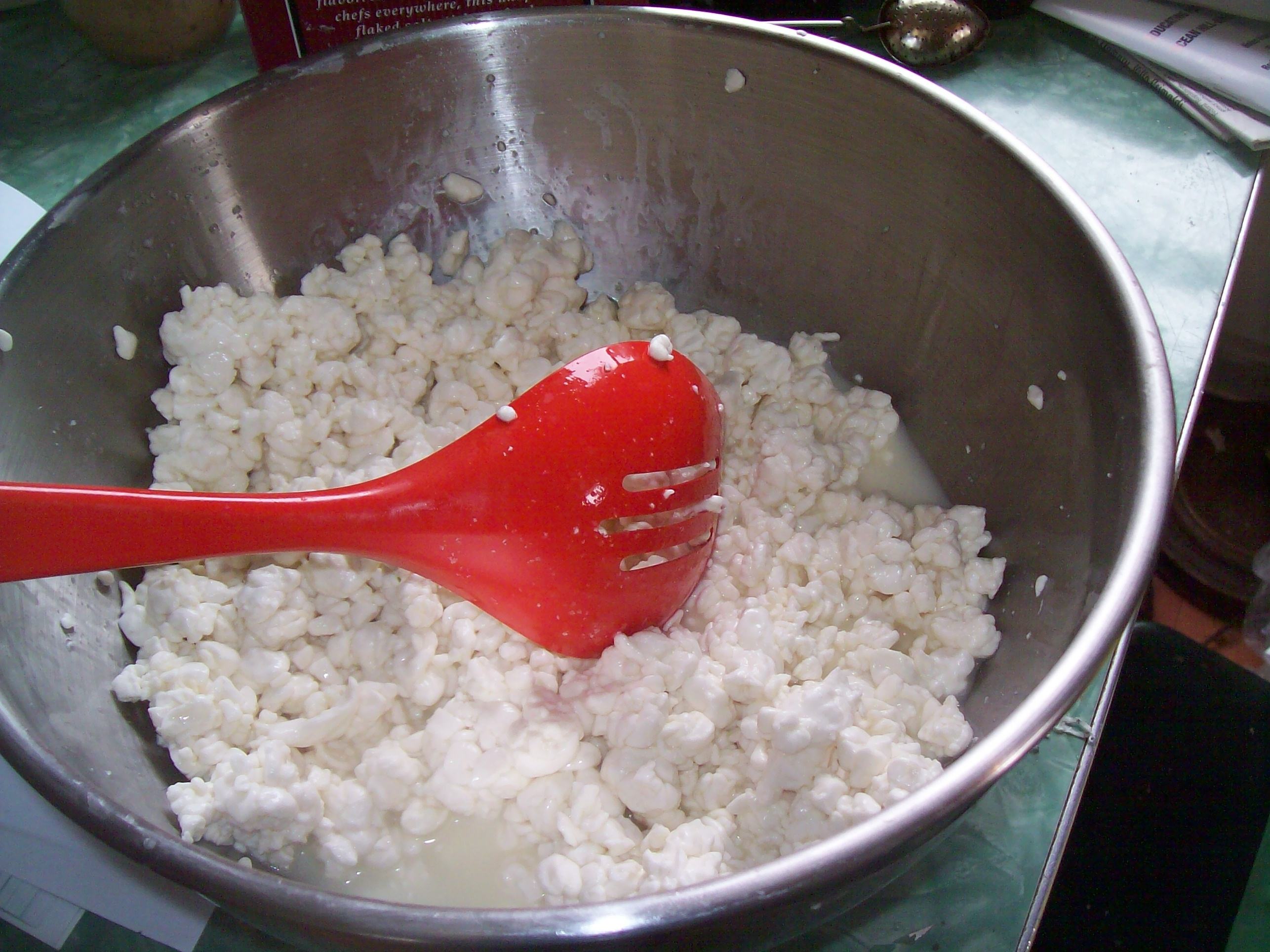
This one requires a lot of milk–two gallons–so I hadn’t tried it before. It also requires a cheese press, which I now have (thanks Mom!). Like all cheeses, it starts by warming up the milk, and adding a starter, which acidifies the milk. After that, rennet is added, which sets the curds. For cheddar, you cut the curds then heat them. Whey drains out, and you’re left with curds that look like this.
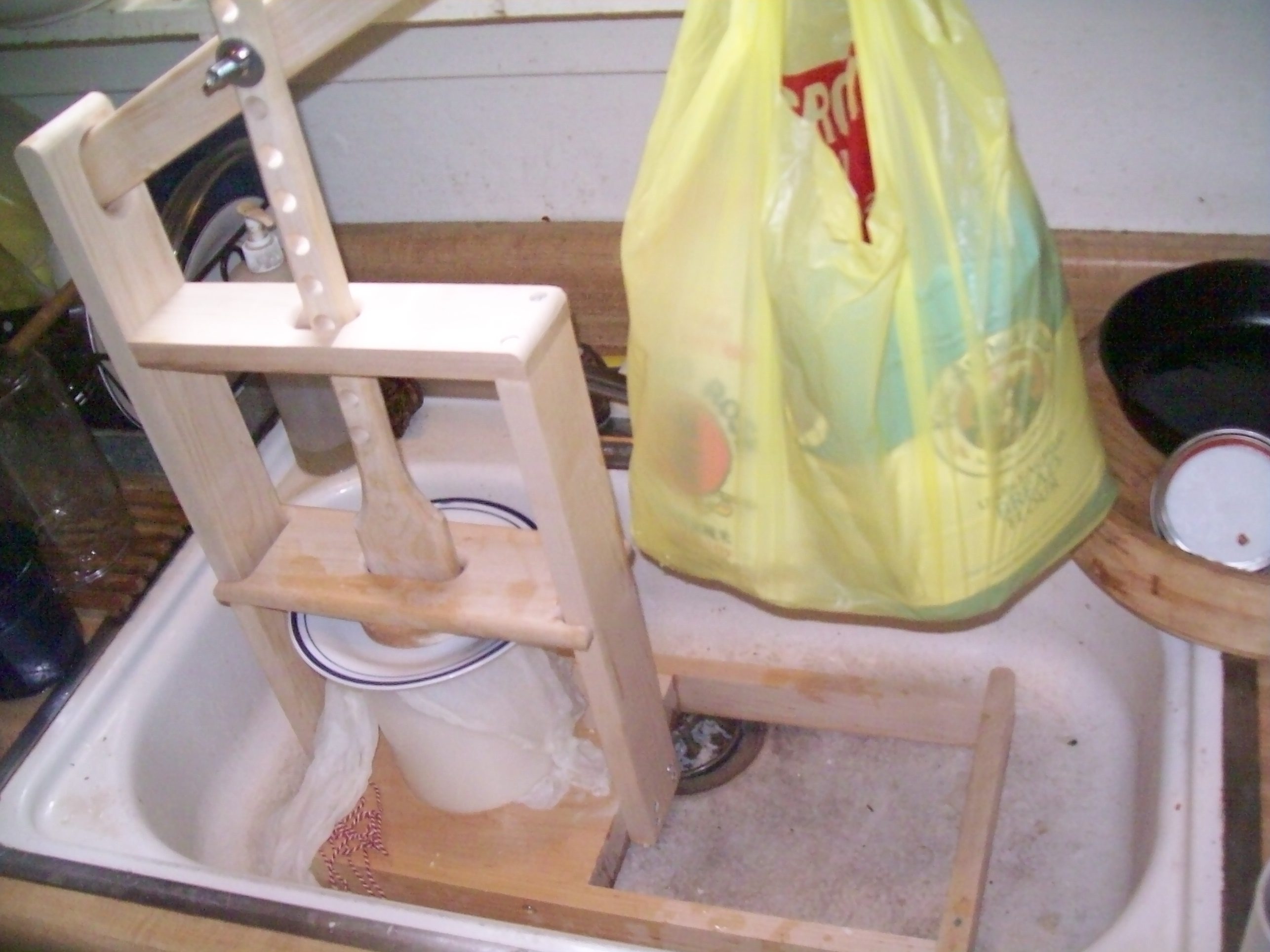
You then pack these curds into a cheese mold, and apply pressure with your cheese press. The molds are plastic with little holes punched into them, so excess whey drains out. I put my cheese press in the sink so the whey would drain out into the sink. This is an old-fashioned cheese press, so you hang weight at certain points on the press to give different amounts of pressure. This is a 5 pound bag of rice, and a 5 pound bag of grain in the 4.0 notch, which makes 40 pounds of pressure. After a few hours, the curd is flipped and then more pressure is applied overnight.

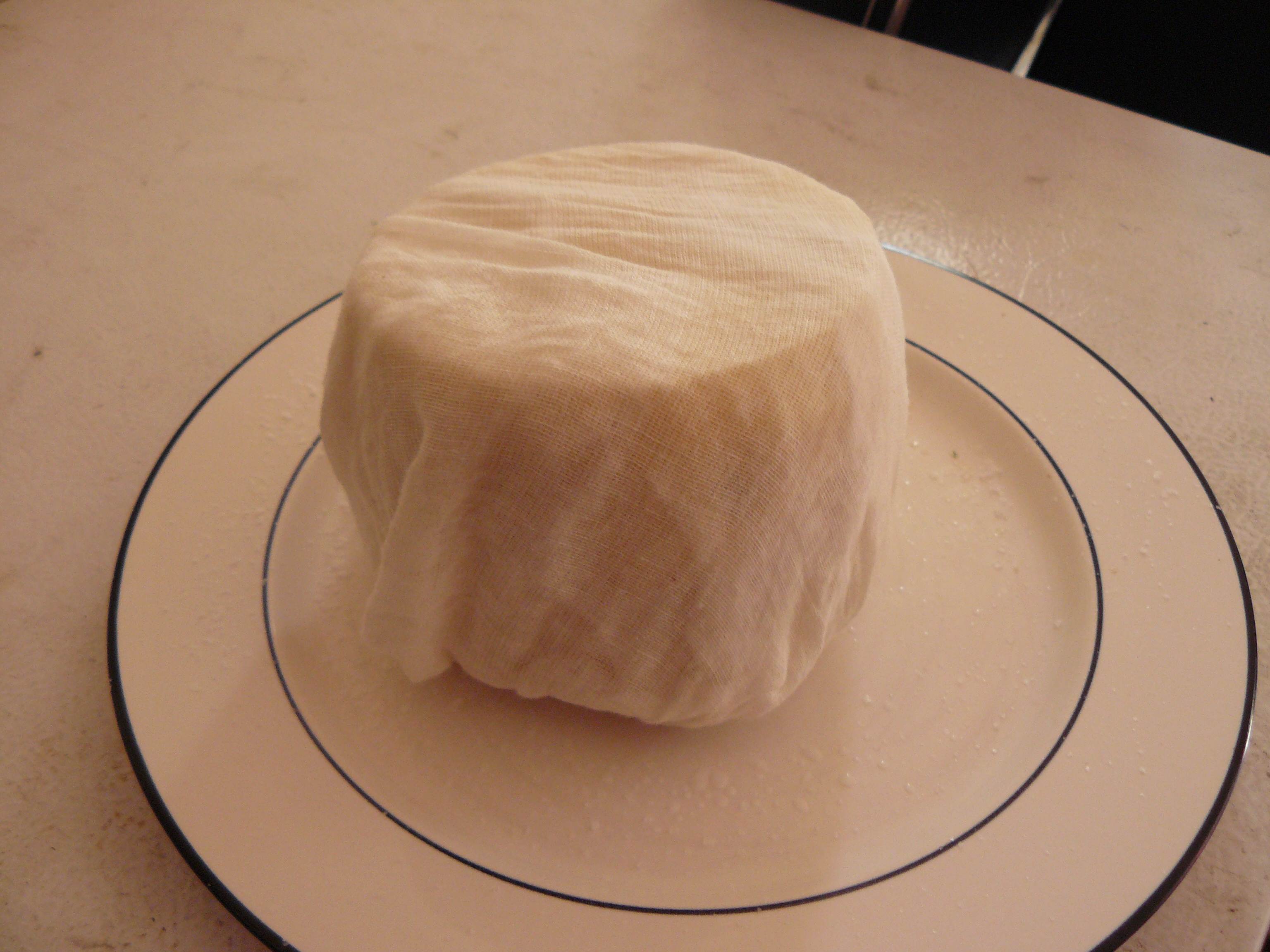
The next day, I took out the curds and they were compacted down. For two days I salted the cheese until it formed a sort of rind. Then I smeared the cheese with duck fat, wrapped it in butter muslin. Bandaged cheddar, ready in 12 weeks!
Blue Cheese

Ok, I adore blue cheese. In France, I had some amazing blue goat cheeses, so I figured I should make my own. It’s basically the same process as cheddar (heating milk, acidifying, adding culture, rennetting) but different in that you innoculate the milk with pencillin roquerferti. And you don’t need a press, you just drain the curds in a mold without pressing. The cheese looks like this on the second day.

You salt this cheese and after a number of days, you poke holes into the cheese. This lets the pencillin get some oxygen and do their magic.
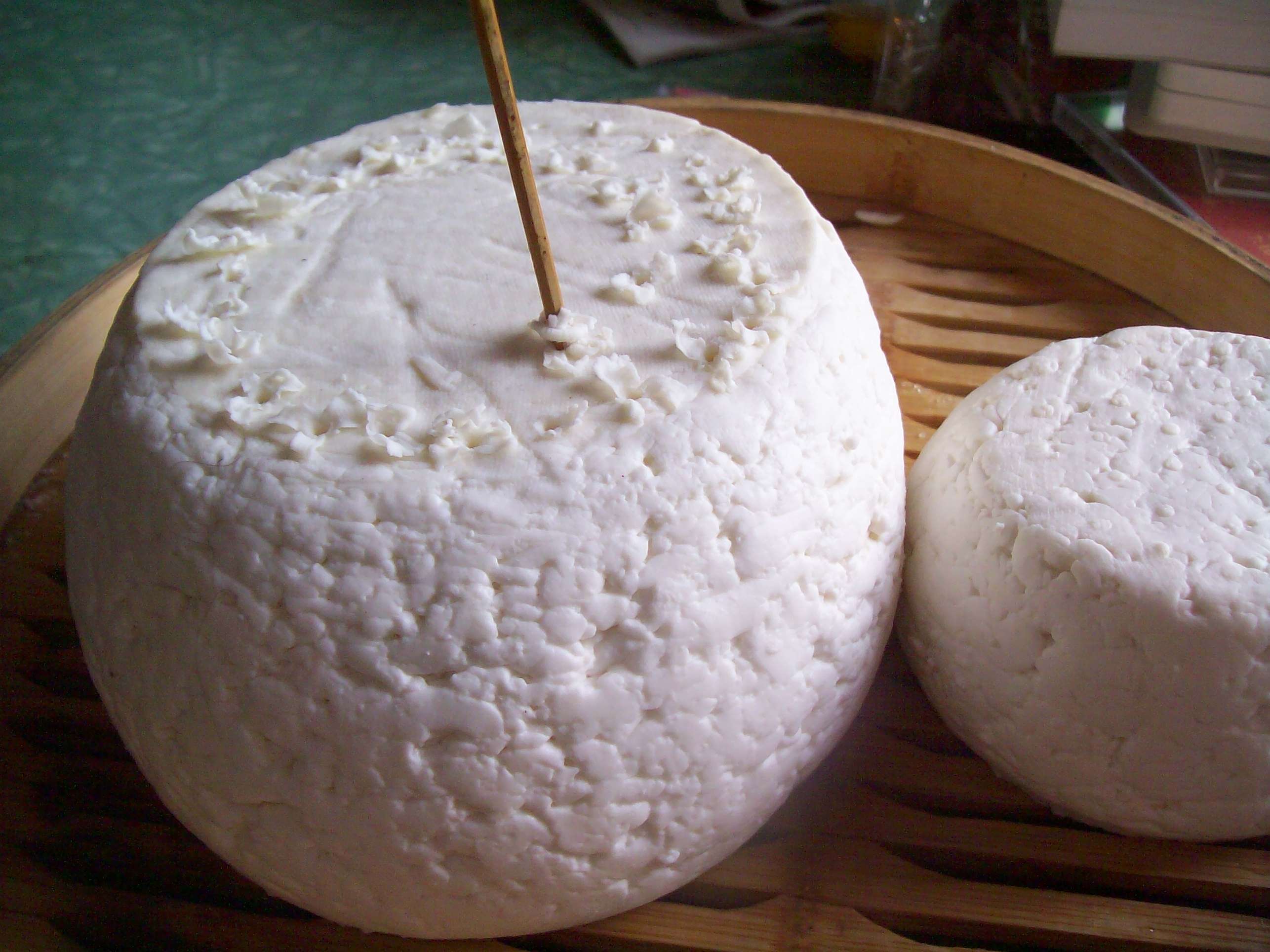
After about 10 days, the blue mold showed up!
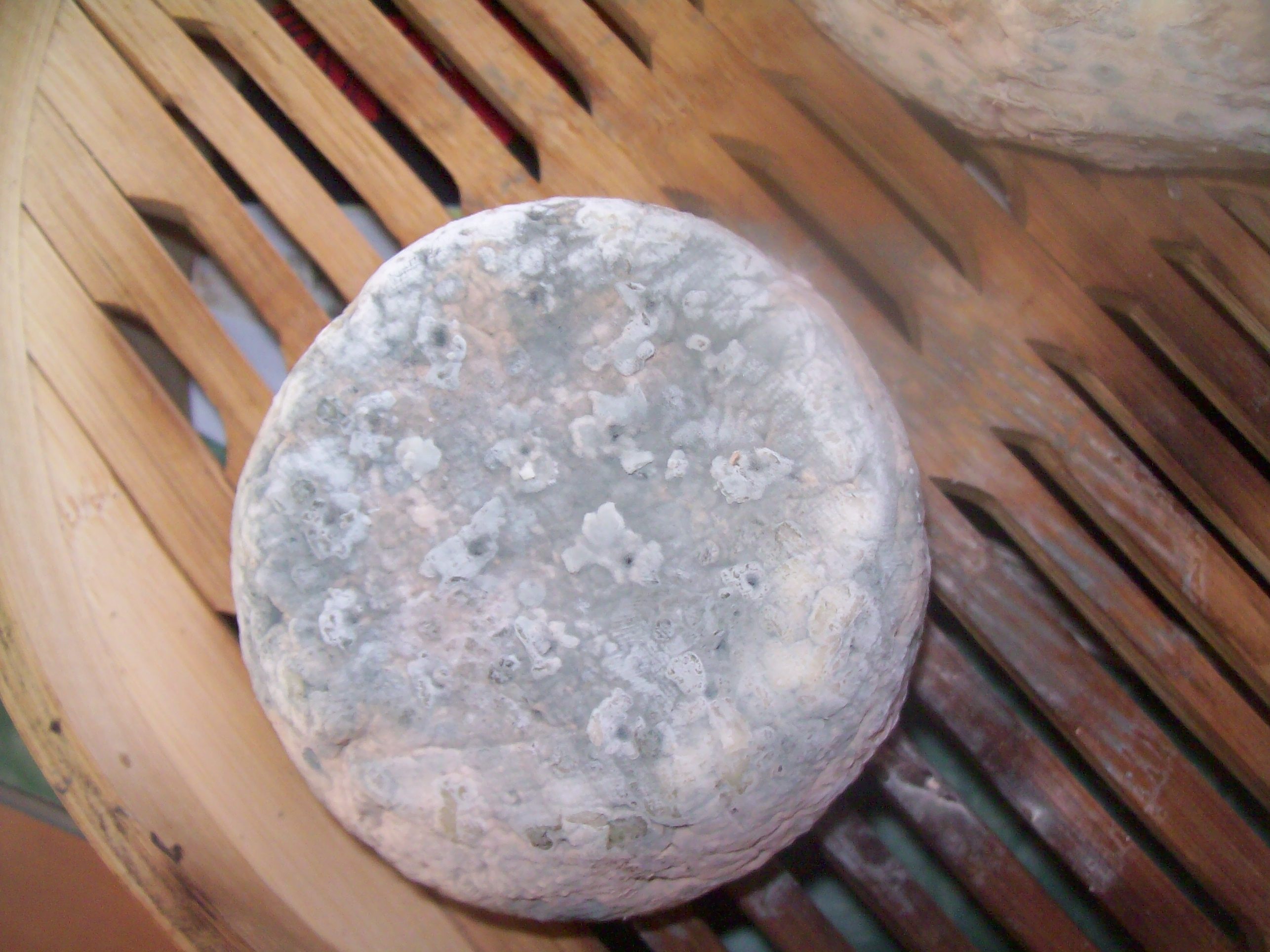
Blue cheese needs 95% humidity so I balance the cheese in a plastic bin filled with water. Who knows if it’ll work? In a few days, I’m supposed to scrape off the blue mold off, let it form again. Then scrape again. This goes on for months! Home Cheesemaking says that making blue cheese is like making a child: easy to start but more difficult as it gets older. And you have to be patient, my blue won’t be ready until May 18!

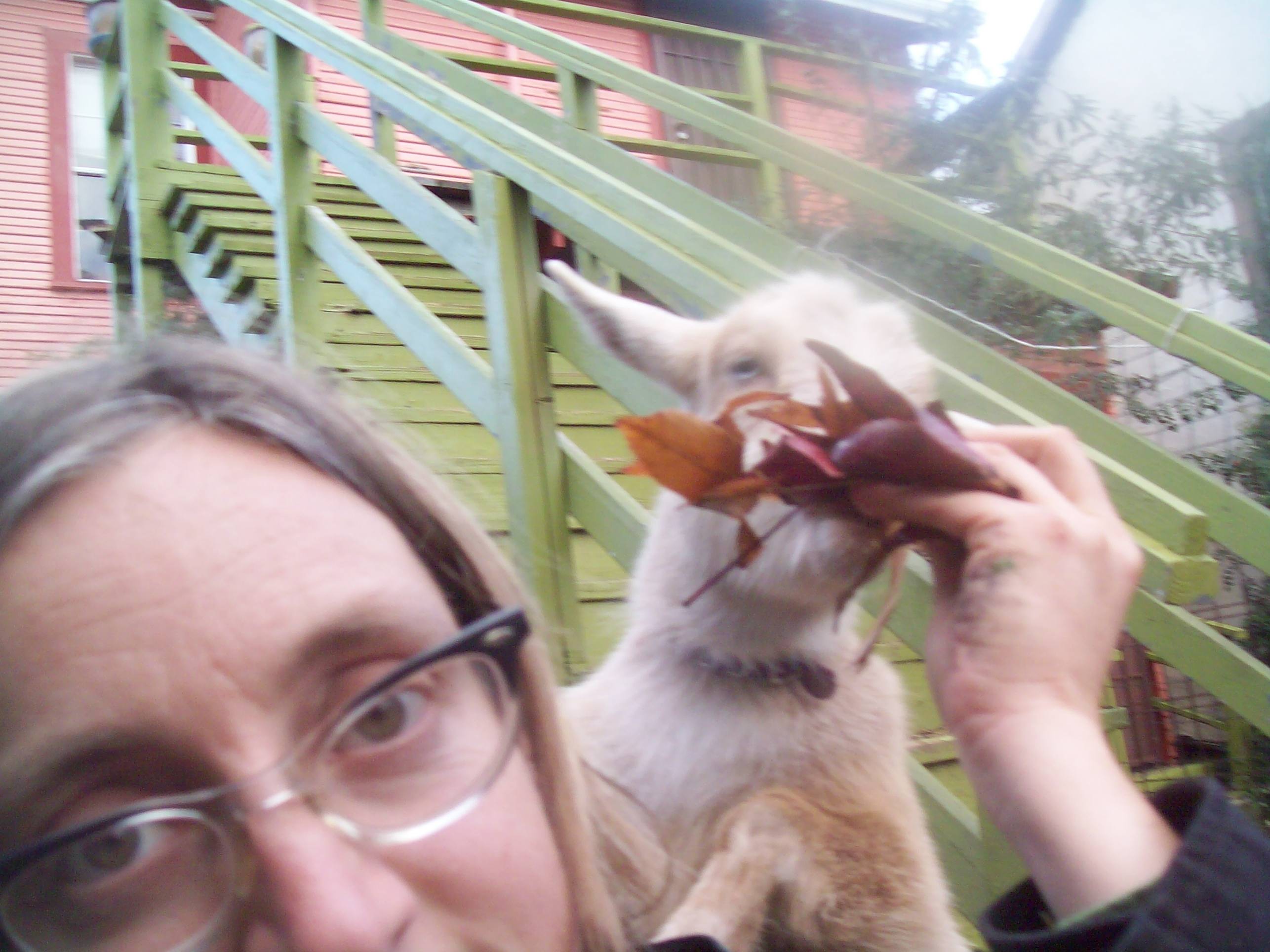
Wait, this is turning into a marathon post! Let’s take a breather to remember and thank the goats!
Mozzarella

I’ve never attempted mozzarella because I heard it used a lot of milk but still doesn’t yield that much cheese. Maybe I did something wrong, but I used 7 quarts of milk and ended up with a couple pounds of cheese. For mozarella, you acidify the milk with citric acid, add rennet, and cut the curd. Instead of fully draining, you add the curd to hot water and massage out the whey.
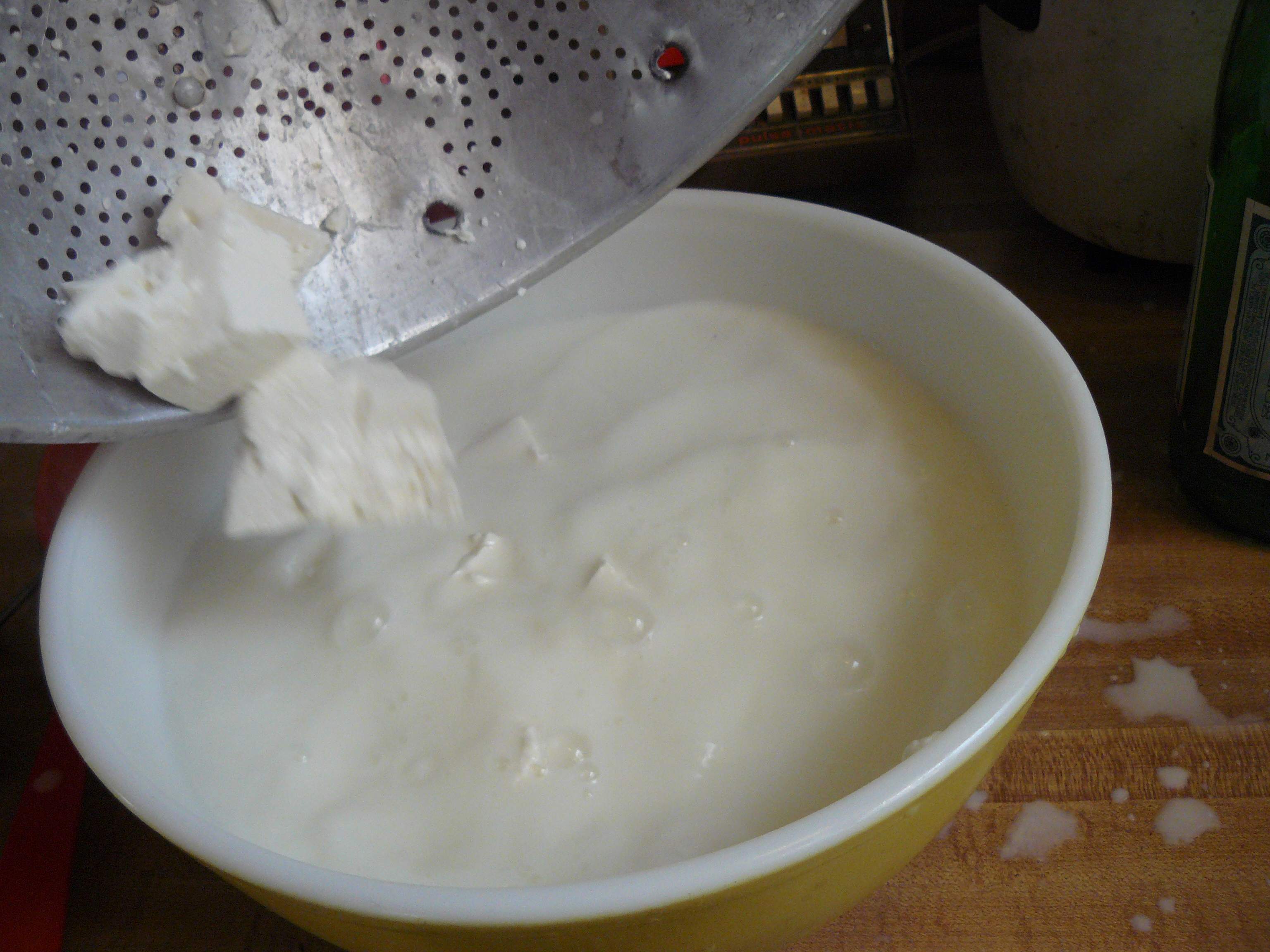
Once the curd is 130 degrees F, you pick them up and stretch and massage them. I really wasn’t good at this and need Samin to come over and show me the proper method. I got better toward the end, but I wasn’t clear on how to form it into nice little balls.
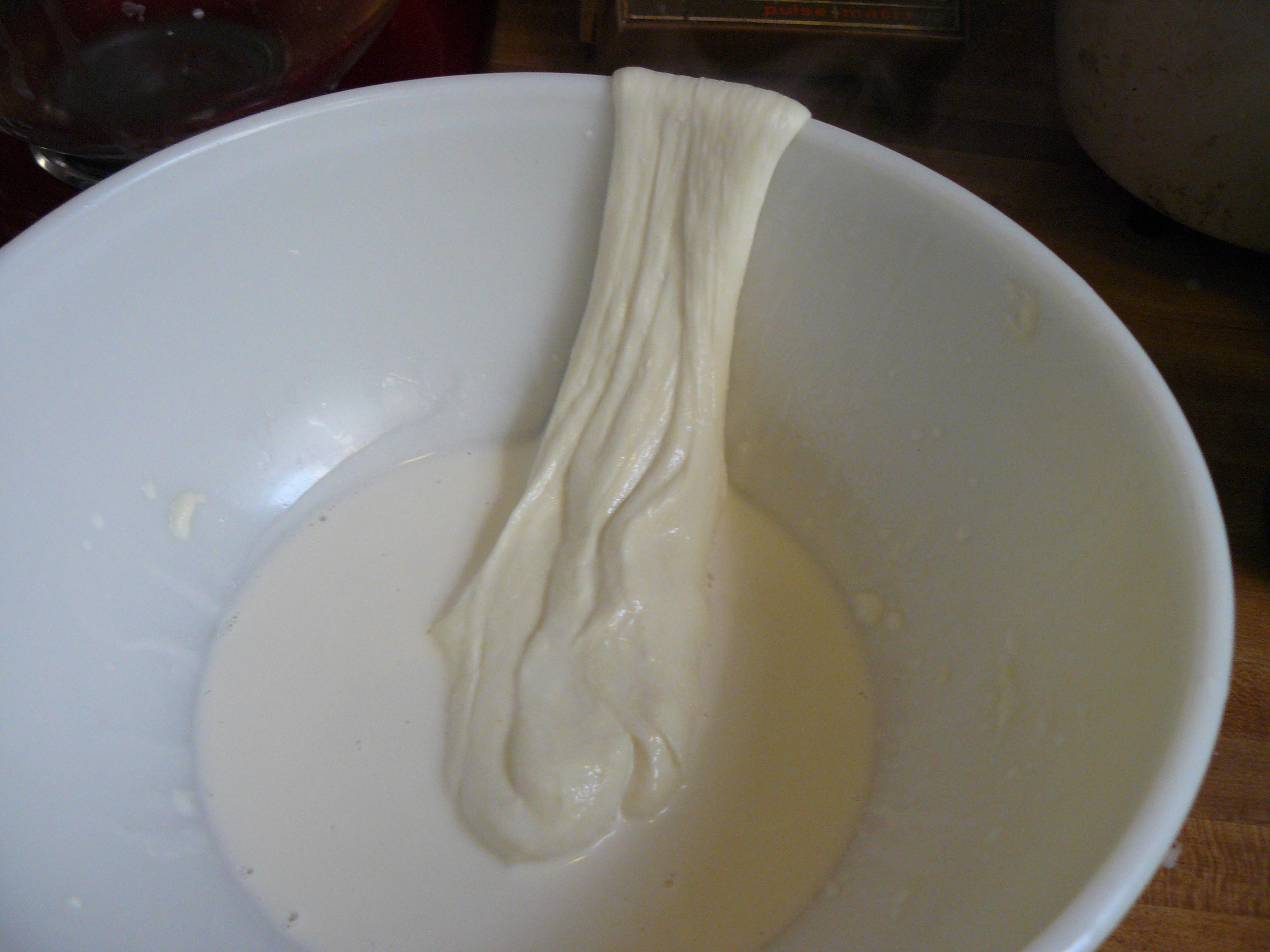
Still, it was delicious on some home-made pizza!

Bloomy Rind Goat

I have made chevre, fresh goat cheese, and it’s really simple. It’s also kind of boring, after the 20th log. So I wanted to make a bloomy rind goat cheese. This involves getting your hands on some pencillin candidium, and inoculating your milk with it, and another moldy friend, Geotrichum candidum. Usual procedure: heat, acidify, add cultures. Instead of cutting the curd, you let it form naturally for 12 hours, until it looks like this.

At this point–whey floating on top, a clean curd break–you can scoop the curds into molds and let them drain for 12 more hours.

Then you flip them, sprinkle with salt. At this point, you can eat the cheese and it’s fresh chevre. But you can let them age and ripen, especially when inoculated with various cultures that want to develop a rind. This time, I dusted them (three of them) with food grade charcoal. This makes the perfect environment to let the candidums thrive and grow. The third photo is the cheese at about 14 days.

I opened the one up without the charcoal and have to admit, I was very very pleased with myself. There’s a nuttiness, a rich flavor with a grassy finish. Fine pate, pure white throughout. I think i’m going to let the others go another week. They might get a little runny inside, which would be very special.

I have some other special cheesemaking dreams, taking my cue from farmstead producers around the world, but with an urban slant. As some of you know, I often feed the goats foraged things like leaves from street trees and jade plant. Their favorite thing right now is Christmas trees. Was thinking it might be neat to make some special cheeses during Bebe’s pine tree binges. I could roll the cheese in, for example, pine needles. Or during the liquid amber leaf frenzy, I could wrap a few in their leaves and let them rot for a few weeks. Just an insane thought I had to share with you.

If you’d like to learn more about cheese, there are some great cheese geek books, one of my favorite is Liz Thorp’s Cheese Chronicles, another is Brad Kessler’s Goat Song, and The Year of the Goat by Margaret Hathaway.  And I heard about an amazing event this Friday, at the Pasta Shop at 4th Street in Berkeley, see details below. Hope to see you there–I’ll be there, learning as much as I can from the masters!

In A Cheesemaker’s Kitchen
By Allison Hooper
Panel Discussion, Tastings, and Book Signing
Meet cheesemaker and author Allison Hooper of Vermont Butter & Cheese Creamery as we celebrate her new book and explore artisan California and Vermont cheeses

Friday, January 15, 2010
5:00pm to 7:00pm
The Pasta Shop – 4th Street Market Plaza
1786 Fourth Street, Berkeley, CA  94710
510.250.6004
www.pastashop.net
No charge except for purchases

Participating artisans cheesemakers from: Bellwether Farms, Cellars of Jasper Hill; Cowgirl Creamery; Point Reyes Farmstead Cheese; and Vermont Creamery
Animal (hide tanning), Vegetable (fermenting), and (fruit) Miracle

If the New Year is getting you excited to learn some new skills, I have a couple fun classes and things to suggest.

1. Scion Exchange

Berkeley, San Jose, Sebastopol, and many more! 

If you have fruit trees, you can graft different varieties onto your tree! Last year, I went to the scion exchange in San Francisco and got some crazy kinds of fruit trees to graft. Sadly, not one of the grafts took, even though I spent hours going to the scion exchange, whittling scion wood and cleft grafting onto my pear and apple trees. The year before I had four take. Clearly I’m getting all Flowers for Algeron on the grafting tip. I need to brush up!  That’s why I’m so psyched that again the scion exchange is coming! This year, it’ll be in several places, I’m going to the one in San Jose on January 9th, because it’s at an urban farm that sounds mighty wicked.  

For more info about dates and times for the scion exchanges, see the California Rare Fruit website.

2. Rabbit Hide Tanning Class with Tamara Wilder

Ghosttown Farm, Oakland, CA

Feb 6-7, 9am-5pm (Saturday & Sunday)

Braintanning is a natural, beautiful & soft method for tanning furs.

In this two day class, participants will partake in the whole process—from prepping and fleshing the pelt to smoking the softened fur.  Tools and materials will be provided and some softening tools will also be available for sale.

Domestic rabbit furs will be supplied.

$120 per person   

Bio: Tamara Wilder has been demonstrating and practicing ancient living skills for the past 20 years.  She is the coauthor of the book Buckskin: The Ancient Art of Braintanning and regularly teaches seminars on stringmaking, braintanning, firemaking and other ancient technologies across Northern California.  More info at www.paleotechnics.com  

If you’d like to sign up or get more information, email me at novellacarpenter at gmail dot com. 

*Never mind if you don’t keep rabbits, the concepts in this class apply for all kinds of hairy critters, including squirrels and roadkill. Tamara is a total bad-ass. 

3. Sauerkraut Making on Valentine’s Day

Biofuel Oasis, 1441 Ashby Ave, Berkeley

February 14, 11-12:30

$25

Come on down the Biofuel Oasis and learn how to make sauerkraut and ginger beer from my friend Leslie, who is mighty knowledgeable about all things fermented. We’ll supply all the raw materials to make a jar of kraut and a bottle of ginger beer to take home to your loved ones–with tastings in between. 

Register here; and while you’re there, check out all the other cool classes like Keeping Chickens and Ducks, Greywater, Backyard Beekeeping, Mushroom Cultivation, and Rabbits!

New Year Resolutions for the Farm

I love writing to-do lists. Not following them, not x-ing them off, but simply writing a list of goals. The end of the year happens to coincide with my birthday, so it’s a good time to take a look at what I’ve done and what I hope to do the next year. I’m turning 37 this year, and it’s my 7th year of squat farming in Oakland. Here’s to another seven!

GARDEN

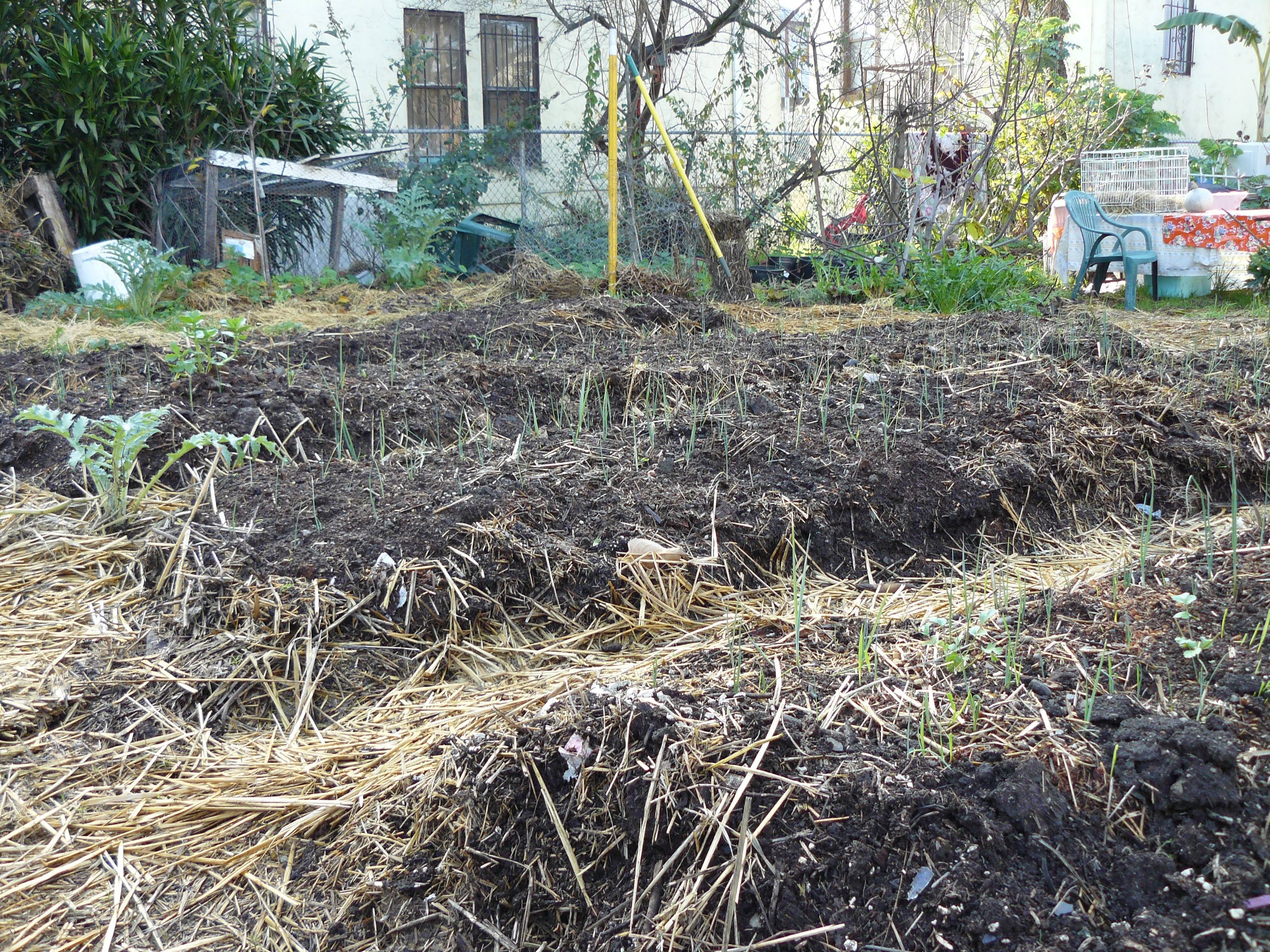
Increase productivity. This year, I’m creating French intensive beds. For awhile I was trying to do those hippie permaculture jungles, but I’m starting to see that for me, it isn’t as productive or easy to harvest as it could be. So I’ve made four raised berms and planted row crops. My idea is to harvest everything at once, add compost, and then plant a new crop. I’ll still do interplanting, but it’ll be more organized. I want to start using the fence more as a scaffolding for growing stuff like grapes and cucumbers, too. With more productivity, I’m going to look for a better distribution model, too.

Save more Water. This summer was drier than a pot smoker’s mouth at dawn. Billy and I really curbed our house water use, and we re-used tons of greywater, but I’m realizing that perhaps summer is not the best growing season for California. To that point, I’m going to grow another crop of dry-farmed tomatoes. But i’m also going to plant a dry-land cover crop in May in many of the beds, and let it run its course through June, July, and August. I can use it for animal fodder.

Pull out Ornamentals. I planted an echium and melianthus major about five years ago and they are huge now. Huge and not producing anything very edible or beautiful. So out they go! I’ll replace them with fruit trees, and a lil’ duck pond.

Deal with Bermuda Grass and that F-ing Perennial Buckwheat. Two horrible weeds. The fact that someone actually gave me the buckwheat just pisses me off. It refuses to die. It also refuses to taste good, and even my animals won’t eat it. This spring, I’ll be hosting a big weed pulling party. I might even hire some local workers, but that last stand of weeds has to go!

BARNYARD

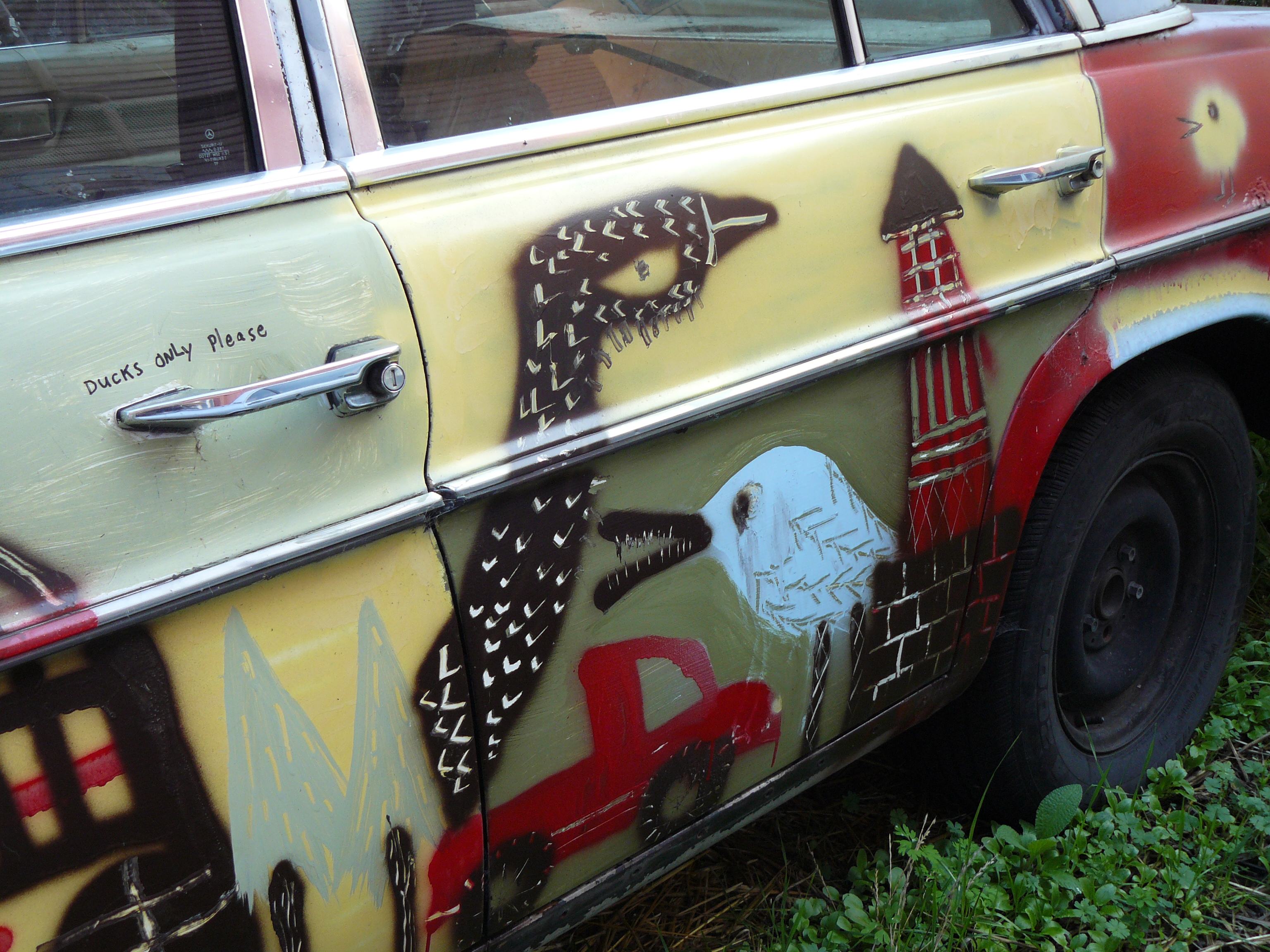
Muscovy Ducks. I am in love with duck confit. Ducks are also great because they reproduce on their own, grow quickly, and are downright cute. And so, our plan is to get a breeding pair of Muscovies and let them do their magic in the garden. We hope they don’t destroy the various vegetable beds. They are going to live in this car–our gutted 240D–at night.

Breeding Hens. A dear friend gave me five of her bantam hens. They are raised by their mother and are more feral than tame, but I think they will be good setters. My idea is to bring a rooster in for my big girls, get them knocked up, and then stash their fertilized eggs under the bantams, who will hatch them out. My goal is to avoid ordering day-olds from the hatchery, if possible.

Rabbit Hides. I need to process the many ones in my fridge and actually figure out a way to use the pelts in a way that honors and celebrates the rabbit. We’re planning a big rabbit gala with Meatpaper and OPEN in early February, so stay tuned.

Guinea Hogs. I know, I said I’d never raise a pig again. But now someone told me about the marvelous, diminutive guinea hog. Never getting bigger than 250 pounds, these delicious piggies weigh 100 pounds or less, and would be perfect for my small farmelette. Dumpsters here I come again!

Requeen. It’s been a while, but I think I need to requeen my bee colony. I love the girls, but they are not as productive as they should be! I’m hoping to catch another swarm and get a second hive going.

HOME AND KITCHEN

Cob Oven. This is on my list every year, and every year it goes by without getting done. But really, it would be wonderful to make pizza and pies, breads and cakes, right?

Cheese Cave. So far, I have a cheese closet. But I’m confident it can be turned into a functional cheese cave. I just have to get some fans, themometers, and various coolers. I want to experiment with making some rind-y cheese, and one day will figure out how the hell Cypress Grove makes Humbolt Fog. This may involve some kind of apprenticeship. These are, from left to right, bandaged goat cheddar (larded with duck fat), fresh chevre, and the 95% humidity requiring Blue Goat.

Wild Food. Sometimes I feel like a dumb-ass farmer trying to grow stuff when nature provides, if you know where and when to look. I want to try to do more harvesting in the wild–acrons, bay nuts, ‘shrooms, nettles, and berries. Maybe some hunting.

Happy New Year to you all; thanks for reading! And please feel free to share your goals on your farm/garden/patio…

Happy Holidaze

I love to say it: merry fucking christmas.

But this year, and I hope for the rest of my time on planet earth (until I become a final hour Christian, har har) I have already celebrated my holiday and I’m all done with this year. The solstice, for me, is the real deal, the real day of celebration, the ‘real’ last day of the year. It’s the shortest day and longest night, but there’s optimism: we reached the turning point when we start getting closer to the sun again. It’s a hopeful time, and Bill and I celebrated by building a fire and opening up our presents sent from loved ones.

The best gift of the year came from my mother–it’s a cheese press!

Above is Bill assembling it; below is it in action, pressing 50 pounds of pressure (I hung 15 pound bags of flour and rice at the end) to my goat cheddar. Ready in 2 months.

I love the end of a year because it becomes a time to think about plans for the New Year.

2010, for me, is going to be the year when I finally grow up and start dealing with my meager finances in a sane way. Lots of people think that because I published a book, I’m rolling in the dough. Alas, this is not true, book sales were good, but not great, and I’m still as broke as ever. While I love the freedom of being a poor writer, I’m getting a little worried about my future: what if I get sick, what if I want to have a baby, what if I want to finally be able to own a lot and plant trees for the future instead of squat farming?

I’ve always had conflicted feelings about owning property–can you really own land? Aren’t we all just passing through? And I hate the idea of owning a house with all kinds of problems and property values and all that crap. My dream for some time has been to buy a small parcel of land in Oakland. I would plant an orchard, run some chickens on it, and feed the people in the neighborhood, in addition to selling weird stuff like Persian mulberries or Green Gage plums to fancy restaurants to pay the rent. In order to buy a lot, though, I have to save up and raise a bunch of money (most banks will not finance a vacant lot).

In order to save money, I might do what my sister Riana, did, where she has pledged to not spend any money for a whole year. I might ask my friends who are good with money how they do it. I might have to do another 100-yard diet, because I’m guilty of spending most of my disposable money on food. To raise money, I’ll have to get mighty crafty. Stay tuned in January for that plan…

Finally, thanks to everyone who came to the Open House at the farm last weekend. Sorry if you didn’t get to do the goat tour–I had no idea so many people would show up! Despite the crowds, there are extra Goat Town T-shirts available. Mostly women’s sizes and shapes. Let me know if you’d like to buy one. They are $25 with postage.

Happy New Year!

Goat Town Tour, Dec 20

Due to popular demand, I’m going to have another farm tour!

When: Sunday, December 20, 11am-2pm

What: Signed copies of Farm City, Goat Town t-shirts, fried green tomatoes, and hot chocolate made with goat milk for sale. Goat snuggling and tours free.

Where: Ghosttown Farm, 665 28th Street, at Martin Luther King

How: Don’t park on 28th Street!! Park on MLK, and walk over. Please. I’ll give you the stink-eye if you drive down 28th Street, which is a dead-end street where my neighbors enjoy parking their cars.

My garden looks like hell, especially in December, so arrive with low expectations.

See you there!

Happy Thanksgiving

Hello! I tried to submit this to the NYTimes Op-Ed pages, but they had too many damn Thanksgiving opinions, so here it is, on my humble blog…. 

Four years ago, I raised my first Thanksgiving turkey on my urban farm in Oakland, CA. My reasoning was the following: I wanted to eat organic, free-range turkey but didn’t have a lot of money, so I decided to do it myself. With this in mind, I did what any urban farmer does: I logged onto the internet and bought a bargain-priced assortment of day-old poultry. A few weeks later I received a peeping box through the US Post Office, my assortment was called the Homesteader’s Delight. The baby turkeys—poults–looked like chicks: fuzzy, adorable, with a little pucker of skin on their heads. As the poults grew, that pucker turned into a dangling snood, and I grew fond of this most American of poultry. They had a curiosity, an openness toward other creatures, including my dumbfounded neighbors. One of the denizens of my street, a strict vegan, even named the turkeys in a bid to turn them into pets, not dinner.

The turkeys lived on my farm for six months. They had a good life and were fed well. They roamed freely. And on one cold November day, one of my turkeys went from live animal to the celebratory centerpiece on the Thanksgiving table. My initial goal, to save money, was a colossal failure: I ended up spending about $100 each on feed for the birds, making it not so cost-effective. Instead of saving money, I learned a few lessons about what it means to eat meat. One surprise was raising a turkey made me feel deeply connected to our human ancestors. A rather post-modern experience—raising a turkey in the city—tied me to the first people who domesticated the animals that appear in farms today. I became part of a long line of historical animal husbandry. Another lesson learned: meat does involve killing. This is so obvious, but it’s a reality that most meat eaters avoid recognizing. Vegetarians and vegans argue that meat is murder. It’s not exactly murder, though, as my turkey wasn’t killed with hatred or malice, but with respect and thanks. A final lesson was that the most important part of animal husbandry isn’t the day of that animal’s death, something we Americans fixate on. No, it is the day-in, day-out of the turkey’s half-year lifetime that should be focused upon. Did that turkey get the chance to run about, to chirp and call, to feel safe, have access to plenty of food, and most of all to be a turkey? The fact that I could answer in the affirmative to these questions, made me feel like I did right by that turkey. And I did right by myself and family and friends, as that turkey was the most flavorful, tender, juicy bird I had ever eaten. I had a deep connection to the turkey that was served for dinner; I had the story of the turkey’s life to share at the table.

This November at my friend’s urban farm in Austin, Texas, I had the honor of teaching a handful of curious students how to raise their own turkeys in the city—something I have done every year since that first time four years ago. I like to point out that anyone who has room for a few chickens usually has enough space to raise a turkey or two. After teaching basics about coops and predator protection, feed and water, I demonstrated how to humanely kill, then pluck and eviscerate a beautiful Rio Grande turkey. As the class helped pluck away the bird’s feathers—the key moment when the bird becomes recognizable as meat–the group grew quiet and reverential. I taught the class because I want people to understand what it means to eat meat. It means a life is lived and a life is taken. Vegetarians and vegans acknowledge this fact more readily than carnivores. Instead of turning away from this reality, I would like people this Thanksgiving to look even closer, to examine where their turkey comes from, how it lived, and how it died. A small-scale turkey farmer friend of mine says she cries every November when it comes time to harvest their birds. Meat is precious. At the end of my class, my students assured me they would never think of turkey in the same way again. They now had a more complete vision of their meal, and they were eager to share that story.

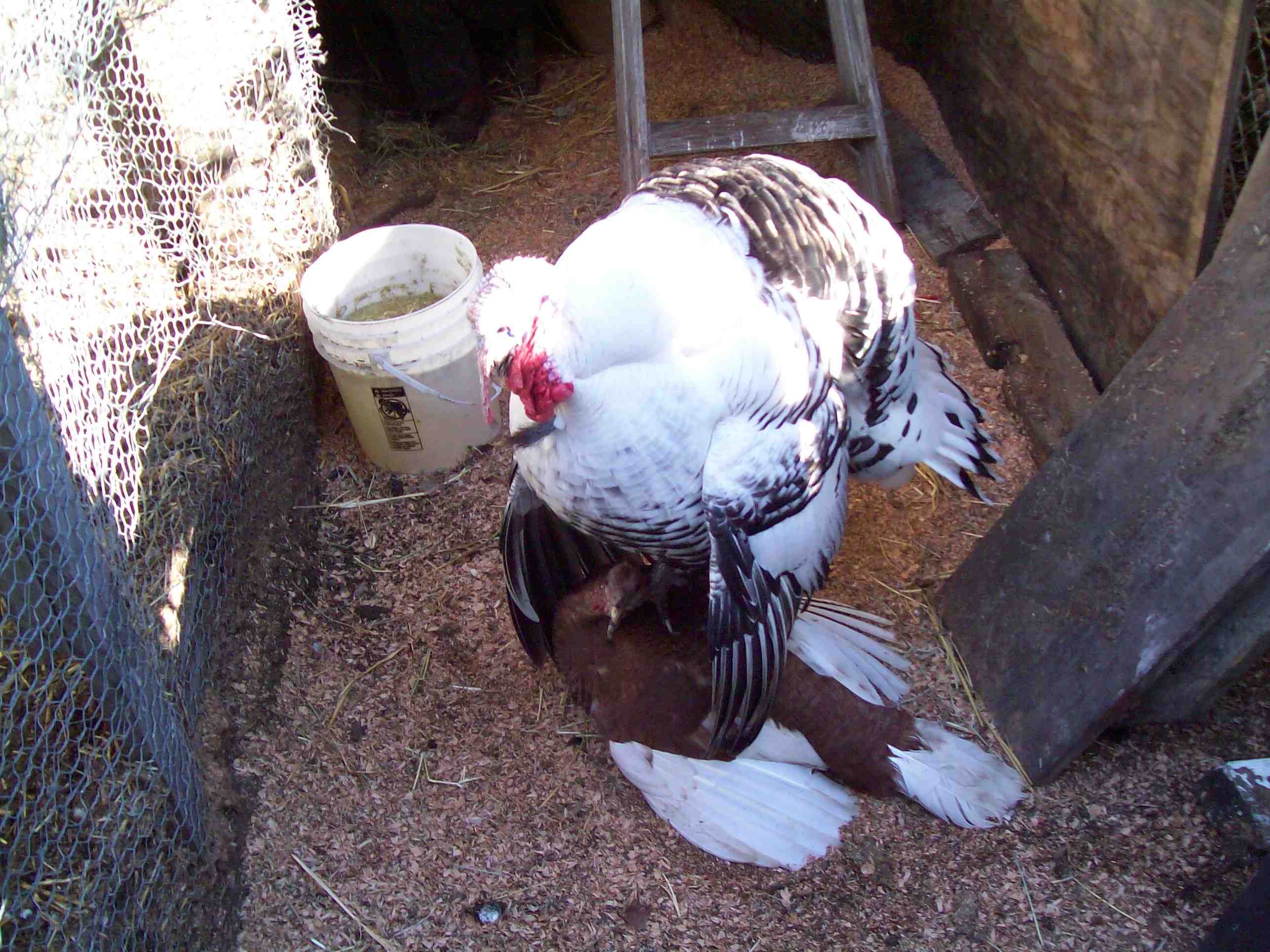
 P.S. I will be braising my turkey Edith (pictured, preparing for turkey sex, on bottom), who was slaughtered as part of last year’s turkey class. She wasn’t able to hatch out any chicks, and grew to be an older bird, and will make a fine turkey soup. Thank you Edith!