Water, water, nowhere

Loved the rain last week. I’m from Seattle, where I hated the constant drizzle and dark but when I moved to dry(ier) California, I learned to love the wet stuff falling from the sky.

This year, for the third winter in a row, we didn’t get our usual amount of rain. Which means we’re facing a drought, with snowpack only at 75%. Which means trouble for my lush vegetable garden and micro-farm.
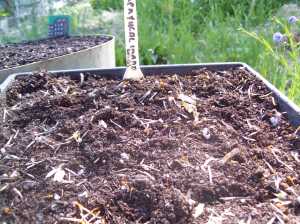
mexiseeds

Unless I flex my puny brain and focus on the options.

One is to downscale. To plant a cover crop and let a few of the beds just rest up and go fallow. I’ve done that with two beds, planting fava beans which I’ll pull up and cover the bed during the summer. Once the rains start again in October, I’ll plant lettuces and greens.

Another is to use more greywater. This is the water that comes from your dishwashing, clothes-washing, hand-washing. It’s kind of clean but not drinkable. Bill and I have been watering our trees with this water for the past two years with no ill effects. We use Oasis soap, which is considered “biocompatible” with greywater systems. Now when we take a bath we’ll dump that water in the washer and do a load of laundry. After the washing machine is done with it, then the water is siphoned out into the garden. So it’s used three times! These are the kind of things that should be encouraged by the government, not made illegal. Check out this website which is trying to encourage a bill that makes greywater use legal in the State of California.

A third thing I’m setting up is a dry-farmed area in my garden. I’m planning on planting corn, beans, potatoes, herbs, and some of the Mexican plants a fellow gardener sent to me. The plan is to water them for the first month or so until they are established and thriving. I’ll mulch them with rabbit and goat turds and a layer of straw. And then, I stop watering. From what I’ve seen, the fruit of the tomatoes become dense and taste intensely tomatoe-y, the potatoes same thing. The corn is for flour and so doesn’t need much water. The beans like it hot and dry. The herbs become more powerful. I’ll let you know how it turns out.
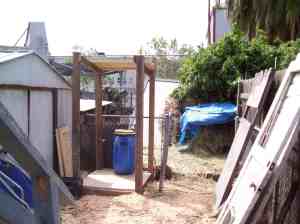
outhouse

Finally, my ultimate challenge: I’m building an outhouse! Here’s the foundation so far. I hope to have it done by this weekend for the hide-tanning class. The idea is that we waste tons of clean water by shitting into it. Water that we could drink–we poop into. Now during a drought, that seems mighty stupid. This will be a composting toilet that contains all poo in a large bucket where it will break down over a few years. I’ll devote a whole post to it and the system once the outhouse is built and is functioning. Can’t wait to carve out that little crescent moon….

Tonight, April 3, Ferment Change Party

Sorry for the last minute notice (you should see how dirty my hair is right now–too. busy. to. bathe.) but here’s a fun event where I’ll be giving a talk about animals and fermentation:

What: Ferment Change: A celebration of Urban Agriculture, Food Justice,
Fermented Food and Community. To benefit CitySlickerFarms in West Oakland, Ca.
When: Friday April 3, 2009
Where: Humanist Hall, 411 28th Street, Oakland, CA 94609
Time: 7:30-10:30pm

Cost: $10-30, no one turned away for lack of funds
Cosponsors: Ecology Center, Humanist Hall, City Slicker Farms, Friends of L.Bacillus

Music By: Zoyres Eastern European Wild Ferment plus others
Contact: maxc@riseup.net

Spring spirit

I am so high on spring. I can’t sleep. I wake up in the middle of the night thinking things like: “I should build a goat pen in the lot” or “tomorrow I need to plant some corn”. My To Do list is long and includes actions that are so physically challenging, I would die if I actually did them all.

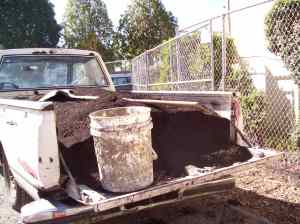
Don’t get me wrong, I’m not complaining—I love this springtime high. And I know I’m not alone. Proof came on Friday when I attended the Compost Giveaway in Berkeley. Every last Friday of the month the City of Berkeley gives away whole pick-ups full of rich, dark, lovely finished compost. All you do is bring your truck, wait in line, and then get a scoop of soil from a bulldozer.
guyinchargeandtrucksI arrived at 8:45 and so did everyone else. Truck after truck after truck, all in a line. Even my friend Willow arrived in her big red bomber truck. First we talked on the phone, then we realized the line was moving very slowly. She came over to my truck. “I’ve never seen so many people here!” she said. The guy in the khakis and buttondown shirt managing the people told us he had never seen anything like the line before either. The fat, cigarette smoking cop looked like he was going to have a heart attack. Did he expect a riot?

I realized that this pack of compost hungry people was tangible evidence of a.) spring and b.) the huge increase in gardening, perhaps during a recession. There were ghetto trucks (mine), sleek trucks with Biblical verse written on it, and rental trucks. There were young people and old people, a guy wearing overalls and a matching child wearing overalls. There were community gardeners, professional landscapers, scroungers, and urban farmers. Everyone likes free soil.
carscroungers
If you didn’t have a truck, there were two smaller piles of compost and wood chips off to the side for people who couldn’t take a load from the bulldozer. These people had shovels and buckets and galvanized laundry buckets, and other weird receptacles to scoop up the black gold. I loved seeing the enthusiasm of all these people. Working so hard so that their plants would thrive. I wondered what their gardens looked like, what they were growing, how they grow stuff. Seeing the people swarming around these piles made me so proud of us. Us humans. We do so many horrible things, but when we garden, we are beautiful.

truckodirt

In the end, I waited about 40 minutes to get my free soil. Was it worth it? I can’t say just by looking at it, but the soil looks beautiful. It comes from the green bins, municipal compost picked up in the East Bay, turned into compost, and then returned to the people. What a lovely cycle.

Thanks for the tip Oliver!

Info:
-Every last Friday of the month is free compost give away at the Berkeley Marina, near the Adventure Playground on the South side of the marina.

Happy Birthday Orla

Well, almost. Orla May was born March 17, 2008 at Ghosttown Farm. I still haven’t sent in her registeration with the Nigerian Dwarf Goat Association, even though I have the paperwork filled out. Bad goat owner!

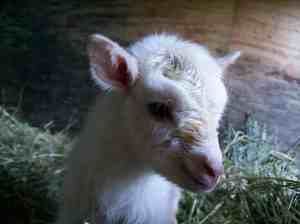
Here’s Orla at two hours old. So adorable. So perfect. So new.

babywhite

This was why it nearly broke my heart when I had to take her to the vet in order to get her horn buds fried off. She and her sister both made sad bleating noises when the vet held the iron up to their tiny hornlets. Thank goodness she doesn’t have horns now that’s she’s a sassy one year old who definitely looks for trouble and is the most stubborn goat ever (next after her mom Bebe, that is). None of the neighborhood kids have gotten their eye gouged out by a toss of her head, for example. Looking back on it, I’m proud that I had them disbudded even though it was a tough decision and it wasn’t so attractive….
hornorla

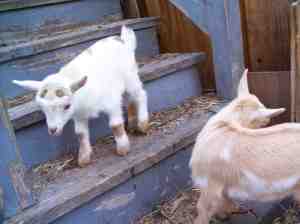
A year later, I find myself becoming more and more nervous because Orla is going to become a mother now. It does seem soon, doesn’t it? Only a year old and having babies? Goats are natural mothers, though, and this early pregnancy is normal. She doesn’t look worried.
orlaonstairs

I, on the other hand, am a nervous wreck. It’s two months before Orla and Bebe will give birth to their kids. Since the last 8 weeks are critical, there’s so much to do. Yet there is no book (yet) called: What to Expect When Your Goat is Expecting. To that end, I’ve been reading all these websites about goat pregnancy and kidding. But I hate the internet. There’s too much information! All those injections seem wrong and freak me out. I’m frantically looking up selenium deficiencies and contemplating a copper bolus injection. I just read that I need to start giving the goats more grain, probably twice a day, with more alfalfa hay to increase their calcium and phosphorous levels. I’ll have to decide whether I’m going to bottle-feed or go natural. I’m leaning toward bottle feeding them myself. But I need to get Bill used to the idea of three plus goatlings in our apartment.

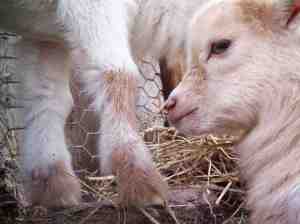
Aside from the dizzying information glut and my nervous nightmares, goat babies might be just like human babies. Because the amazing thing is: the stress is all worth it when they join us here on this Earth. goatlegs

Triamble: A Love Story

I once worked for a certain professor who used to get tons of food-related books in the mail. One of the books was the Compleat Squash by Amy Goldman. “Do you want this?” he said one day when we were cleaning out his office bookshelves. I opened up the book. A few pages into it, I knew what it was: pumpkin porn. “Hell, yeah,” I said and took it home.
triamble1

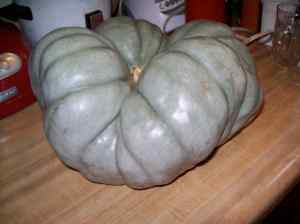
That night I looked through each of the glossy pages, skimmed the text, with growing awe of the author, whose obsession with pumpkins and gourds and squash has led to a pumpkin curing barn, for example. I found myself staring at a blue-colored cucurbita maxima called Triamble. It’s one of Goldman’s favorites (and she is harsh on some of my favorites). “I adore Triamble for every reason in the book,” she writes, “… with the dense abundant flesh (there’s no hole or seed cavity, in these pumpkins) are about the most highly evolved pumpkins on the planet.”

It’s called Triamble because they have three triangular lobes. I had grown some of the squash in the book: Galeuse d’ Eysines (warty and wonderful but also watery). Blue Hubbard (yum). Rogue vif d’Estampes (the Cinderella pumpkin). Kabocha. Turk’s Turban. Butternut. Acorn. And then, I decided, I would grow Triamble.

First I had to find the seeds. I looked all over and finally saw them in the Seed Savers catalog. Since I knew I wanted to save the seeds, I planted only one c. maxima variety–the Triamble. It didn’t stop me from planting other cucurbits–I grew a Thelma Sanders, which is a c. pepo and thus wouldn’t cross pollinate with the maxima.

The Triamble plant sprouted and ran wild around the garden. Sprawling, sprawling. It is an ambitious squash. I got a fair number of small triangular fruits. They looked like pieces of art in the garden, blue against the green foliage, that wadded up shape that my friend David said looked like a piece of chewing gum. I managed to pull about 15 fruit off the plant–one was very large and had, somehow, four lobes–and let them sit in my kitchen on top of the fridge to cure.
triamblecut
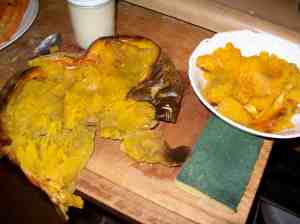
I ended up giving many of them away to friends as art objects, door stops, gourd-y decor. And then, I started to cook them. Inside, they are strikingly orange. I was pleasantly surprised at how easy they were to cut in half. The skin was brittle but not like armor like some squash I’ve met before.
triamblecooked
So far I’ve made soup, curry, pumpkin bread, donuts (yes!), and pumpkin pie from the lovely Triamble. The flesh is outstandingly dry, dense, and like Goldman promised, abundant.

I’d like to share the abundance–I saved some seeds from the biggest Triamble. If you’d like me to send you some, send me your mailing address (novellacarpenter at yahoo dot com), or come by to pick them up on the farm tour this Saturday, 10am-12.
triambleseeds

Update: i’ve gotten your requests and i’ll send seeds to you all this weekend! also, someone said the email didn’t work–try novellacarpenter (at) gmail dot com

Veggie Oil

Hello. Of course you know you can power your diesel car with vegetable oil. But the details, for many people, become a little hazy. To that point, the lovely Moe B and myself will be co-teaching a class about all the ins and out about using veggie oil instead of that stinky dino-diesel.
svo
If you’re interested, details are below:
Veggie Oil 101
Thinking about converting your vehicle to run on straight vegetable oil? This class covers basic theory, veg oil collection, issues, and explains the different types of conversions available. Also, local conversion kit installers will talk about their kits. Taking this class is a great way to educate yourself about SVO options.
Sunday March 1st 11 a.m- 3p.m.
Cost: $40
To enroll please email: Biodevas@biofueloasis.com with the subject heading: March 1st class.